Siddha Varmam
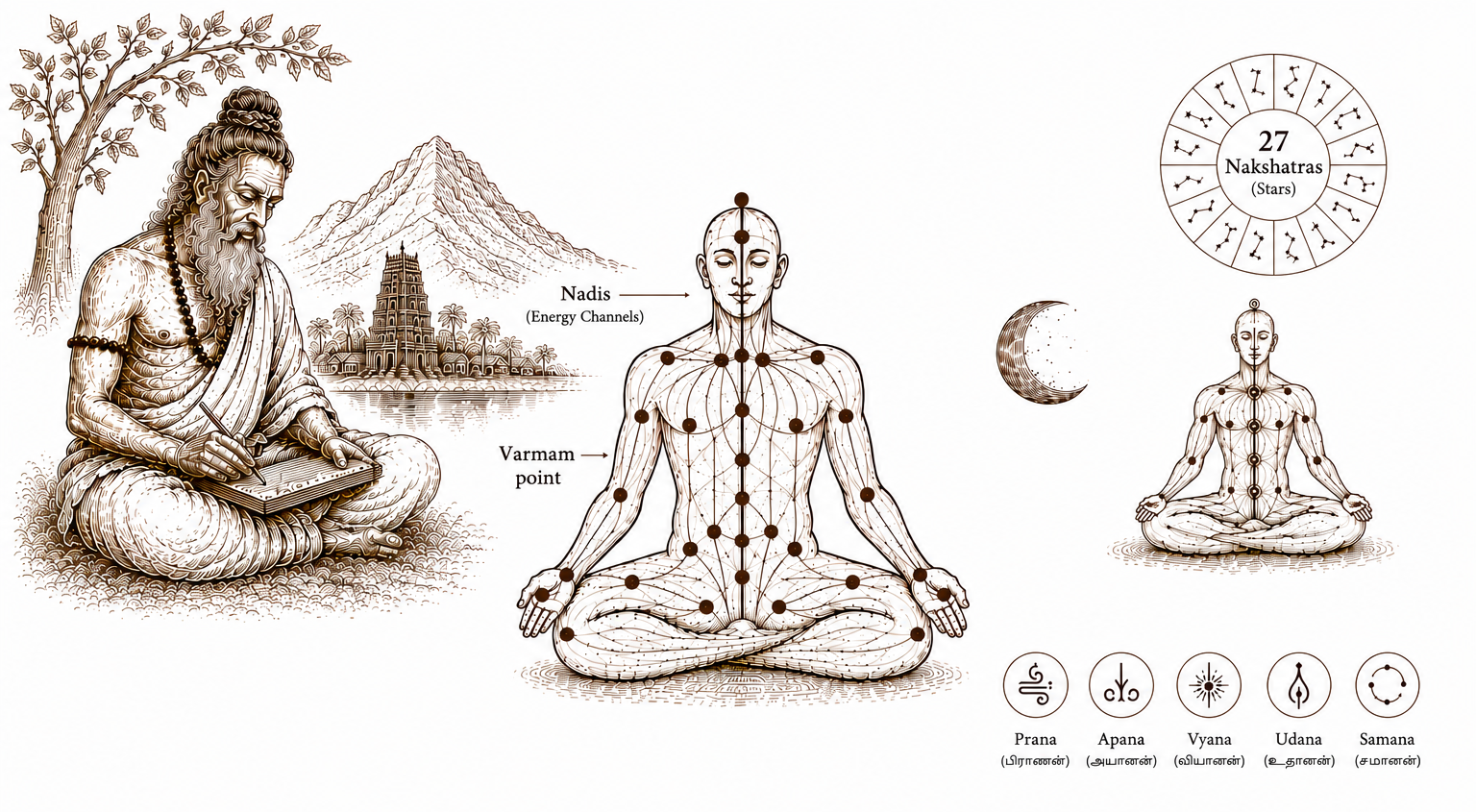
One of the most cherished arts within the Siddha tradition is Varma Kalai. Varma Kalai has two aspects, the martial art and the healing art. Among these two, the healing art is considered the higher expression of Varma Kalai, with the potential to address both acute and chronic diseases.
This sacred art works with the hidden vital points in the human body, traditionally enumerated as 108 Varmam points. These points are quite vulnerable and can be used to treat or harm. For this reason, in ancient times a student had to spend twelve years with the master, before he received an initiation into the first Varmam.
Varma Kalai is a hidden art not only because of the concealed nature of these vital points, but also because of the subtle way one must relate to each one them. Each Varmam responds only when the correct amount of pressure (Mathirai) is applied, combined with specific directional movements. Furthermore, for the successful treatment of any disease, the correct sequence of point application is essential.
Varmam can be understood as a gateway between the physical and the subtle, also binding the two together, much like how two Lego pieces interlock. The studs and cavities of the Lego resemble the Varmam points.
In the human body, vital energy travels through subtle channels known as Nadis. At specific locations along these pathways, the energy slows down and accumulates, creating a vortex-like movement before once again propelling itself forward on its journey. These locations are known as Varmam points. They are dynamic centers where vital energy is concentrated, sustaining the flow of life force (Vasi) throughout the body's energetic network.
Any disease or disorder represents a deviation from the body’s natural functioning, and this deviation is registered in both the physical body and the subtle dimensions of our being. True healing therefore requires addressing both levels, with greater emphasis on the subtle dimensions, as this is where the root cause of a disorder resides.
This art includes a detailed understanding of Varmam anatomy and physiology, and how these functions are transmitted and expressed from subtler principles, such as the three Doshams, the ten vital airs (Dasa Vayu), and the twelve energy channels (Nadis). The human body is animated and sustained by these subtle forces. Varmam is the mastery of how to recognize and correct imbalances at these subtle levels.
The foundation of this sacred art lies in the Varmam points. However, there are many different applications through which Varmam and Nadis are approached and worked with, other than the basic Varmam point applications.
One such unique practice is Narambu Murichal (often described as nerve massage or nerve unwinding). In this method, accumulated tensions, tightness, and blockages within the nerves are released through precise and specialized massage techniques. And along the process of applying Narambu Murichal, Varmam points are addressed in a sequential manner.
Another distinctive Siddha Varmam therapy is known as Adangal Massage, in which multiple Varmam points are stimulated sequentially and repeatedly, producing a powerful therapeutic effect. This form of massage is particularly effective in treating chronic and stubborn diseases, where deeper and more sustained intervention is required.
Beyond the therapeutic applications of Varmam, there are more advanced healing modalities, such as Pancha Prana Nadai and Amritha Kalai. These two disciplines belong to the Aga Guru lineage of the Siddha tradition and represent higher methods for regulating and harmonizing the flow of life force within the human body.
Varmam is a vast art and there is no limit to how much a practitioner can evolve within it. Following is one of many esoteric aspects touched by this art, just to give an idea to its depth and vastness.
In the Siddha system, the human body is a microcosm of the cosmos (as the macro so is the micro). Whatever exists in the universe, equally exists within the human body.
Nakshatras (stars) influence specific regions of the body. Varmam points are the gateways where the cosmic intelligence through the Nakshatras meets the vital life force in the human body. Disease arises when this harmony is disturbed. Thus, Varmam therapy is not merely physical manipulation, it is a way of re-tuning the body to its cosmic order.
There are 27 Nakshatras affecting the Nadis (energy channels). One of the esoteric aspects of Varmam is the consideration of the birth star (Pirandha Natchathiram) of the patient and his/her current planetary transits in determining the mode of treatment.
Also, for some Varmam, the time of treatment is considered because certain Varmam points respond more effectively at specific times, while others should not be stimulated during certain times.
Varmam can also pacify planetary disturbances related to chronic or recurring diseases. This is why in the Siddha practice, Varmam, astrology, etc. are not separate disciplines.
Varmam works where medicine stops, because planetary affliction imprint first in the subtle bodies and finally manifests as a physical disease. So here, the hidden root cause of the disease lies within the subtle dimensions of our being, which is easily accessible through Varmam application.
Likewise, the Moon, waxing and waning through its monthly course, influences corresponding Varmam points. It is a monthly movement of nectar in the human body according to the lunar calendar and it is a vast art by itself. In this way, the sacred art of Varmam reveals itself as an ever-continuing tapestry of subtle intricacies.
My first encounter with this sacred art took place seventeen years ago in Tamil Nadu, India, in the ancient city of Thiruvannamalai, the abode of the sacred mountain Arunachala.
One day, while walking through one of its old streets, I happened to meet an old friend who told me about a unique Siddha healer who offered consultations and medicines free of charge. Intrigued, I fervently asked him for the healer’s phone number and called immediately. I was simply asked to come on Friday. When I arrived early on Friday morning, I found a large crowd of people, all waiting to see the Siddha healer. I was told that this scene repeated itself every single day. The healer’s popularity intrigued me. The rule was simple, whoever came first was seen first. And so, I waited for several hours before my turn finally arrived. When it did, a man with a limping leg, later revealed to be the healer’s devoted assistant, guided me into a small room. There, the Siddha healer sat cross legged on the floor. He signaled to me to sit in front of him. He giggled for some time and introduced me to his siddha lineage represented by a picture of the 18 ancient Siddhas placed to his right side.
I was deeply touched by the approach of Dr. Pal (as he was known in those days) in the way he conducted his consultation and addressed the physical, mental, and emotional aspects of my being. It was a profoundly helpful and deeply moving encounter. At the end of the consultation, he asked me to return a few days later to collect the Siddha medicines he would personally prepare by hand.
At that time, I was immersed in the study and practice of Ayurveda and was planning to travel to northern India to further my practical education in this tradition.
I was aware of the art of Varmam, but I had no interest in learning it. I considered it a lost art and could hardly imagine that there might still exist a true master of this ancient science.
However, after meeting Siddha Pal Pandian, I felt compelled to ask whether he knew and could teach me this hidden and elusive art. On my next visit, when I returned to collect the medicines, I asked him about Varmam. To my great fortune, this simple inquiry eventually led me to study this art under his guidance in its genuine and authentic form.
Through this path, I was embraced by the Siddha tradition and the Aga Guru Lineage of Siddha Pal Pandian. What began as a search for healing evolved into a lifelong journey of learning. Over the years, I have continued to study not only the art of Varmam but also the spiritual teachings and practices of this lineage, a blessing that continues to enrich my life to this very day.
