An introduction to MM (Minimalistic Movement) Workshop
The Body: Our Primordial Temple
Our body is the very foundation of our existence in this world. Without it, we could neither experience life nor communicate with our fellow beings. This is such a fundamental truth that it should require no explanation. Yet, throughout our lives, we continually neglect and abuse our bodies in countless ways. In this era, it almost seems as though we have become increasingly creative in finding ways to undermine our own well-being.
At the most obvious level, we harm our bodies through unhealthy eating habits, physical inactivity and other lifestyle choices. But there is a subtler and perhaps more profound level of neglect: the accumulation of experiences that we fail to fully process and integrate, which we now commonly refer to as stress and trauma. These undigested experiences do not simply disappear. They leave their imprint on our inner world and our relationship with our bodies.
Another, more fundamental form of neglect arises from our preoccupation with the image we wish to project to others. We become attached to how we are perceived, investing enormous energy in maintaining an image that may have little to do with who we truly are. In doing so, we gradually become alienated from our core being. We become strangers to ourselves and eventually, even to our own bodies.
These aspects of our existence cannot be separated. The more honest and transparent we are in our relationships with others, the more grounded we tend to be in ourselves and more connected to our bodies. The reverse is also true.
The mind has a remarkable ability to construct narratives, sustain beliefs and create realities that serve the image we wish to maintain. The body, however, continually offers us a more immediate point of contact with our actual state of being. It registers everything we experience, often revealing what the mind would rather conceal.
Our body is our first temple. All external temples come afterwards. Yet, we often devote considerable attention to keeping our external temples clean, beautiful and tending to the sacred presence that resides within them through rituals and acts of devotion, while all along neglecting the very body through which we experience life itself, overlooking its needs, its wisdom and the sacredness of its existence.
This contradiction reveals something about our priorities. We seem to value what can be seen, judged and appreciated by others far more than what is happening within us. The maintenance of our self-image takes precedence over the cultivation of an honest relationship with ourselves. In this way, we become increasingly dependent on our surroundings and the perceptions of others, sacrificing our inner freedom in the process. Throughout it all, our innocent body bears the consequences, silently carrying the burden of the life we have created for ourselves.
To care for the body, therefore, is not merely to maintain its apparent physical health. It is to go far beyond that and cultivate greater organic honesty, organic awareness and organic integrity in the way we inhabit our bodies, move through our surroundings and experience the world through them.
In this sense, our body can serve as a measure of how far we have strayed from our true nature, or how deeply we remain connected to our core being. Learning to listen to the body is therefore a subtle art. And when cultivated with sincerity and organic awareness, this art can become one of our greatest teachers, perhaps the most reliable of all.
Perhaps the real question is not simply how well we take care of our body, but how deeply we are willing to inhabit it. Before tending to any external temple, we might first learn to honour the one through which we experience our very existence.
In the ancient Siddha tradition, which is more relevant than ever to the needs of our time, the body is the foundation of a healthy relationship with ourselves as well as others.
This is a main pillar of the Aga Guru lineage of the Siddha tradition. The primordial intelligence that created and formed the body when it was in the mother’s womb and continue to sustain it all through our life, is intimately embedded in and intertwined with every cell of our being, though It lies hidden due to our deviations and alienation from our body. So, why to go outside in search of That which already resides within our body with all its glory and immediacy.
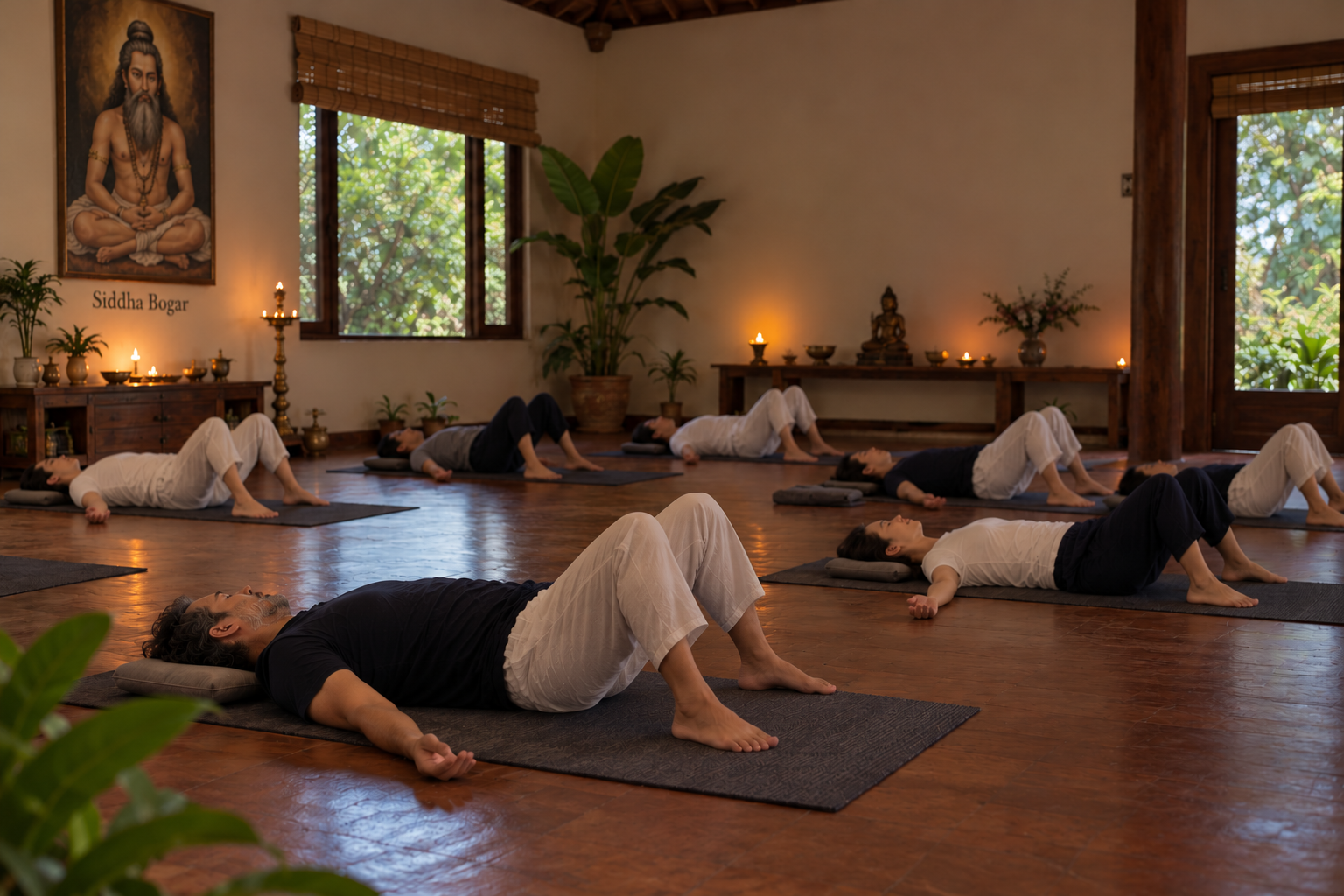
This is the core principle of the foundational practices of the Aga Guru lineage, which are shared through the Minimalistic Movement (MM) workshop.
These principles and practices are so unique to Siddha Pal Pandian’s lineage. They are so simple and yet very easy to miss, due to their organic nature. There are two main hindrances that can prevent participants from truly benefiting from these practices and the principles underlying them.
Approaching the practices with a prejudiced mind
One of the greatest obstacles is approaching the workshop with the conviction that “I already know.” When the mind is convinced that it understands something, it leaves little room for genuine discovery. The simplicity of these practices can easily be mistaken for something already familiar, causing us to overlook what is actually being revealed through direct organic experience.
The mind's dominance and our alienation from the body
We live in a world that places immense value on the mind, encouraging us to rely on it, cultivate it and use it as our primary means of understanding ourselves and the world around us. Consequently, we often become alienated from our own bodies, even when we believe we are connected to them.
Here lies a subtle but essential distinction: Are we able to be with the body organically, allowing the experience to unfold naturally or are we unconsciously relating to the body through the mind? In the latter case, what appears to be embodiment may actually be a mental construct, a form of pseudo-embodiment or a pseudo-organic experience. The majority of the people nowadays lie within this category.
Recognising this distinction requires honesty, sensitivity and a willingness to look beyond what we think we know.
Ultimately, two things are essential for engaging with the depth of these practices and principles.
The participant's responsibility and maturity. The participant must be willing to approach the practices with openness, sincerity and the maturity to recognise their own conditioning and limitations.
Understanding that this is a journey ever in progress. Genuine embodiment is not something to be grasped intellectually or achieved through force. It is a process of gradually restoring our relationship with the body, allowing a more organic connection to emerge through sustained practice and direct organic experience.
The inner path of the Aga Guru lineage within this ancient Siddha tradition is so rich in what it has to offer. The MM workshop is the foundation of one’s journey along this path and there’s no limit to how much one can progress in it. Having said that, as my Teacher usually says, all the so called advanced levels lie within the foundation itself.
